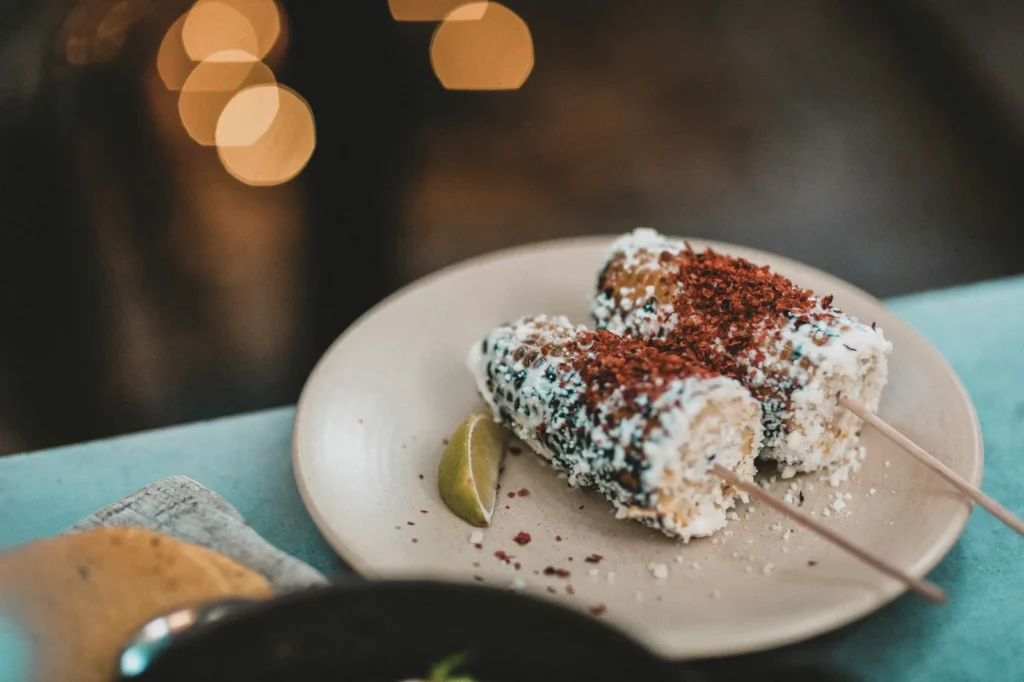
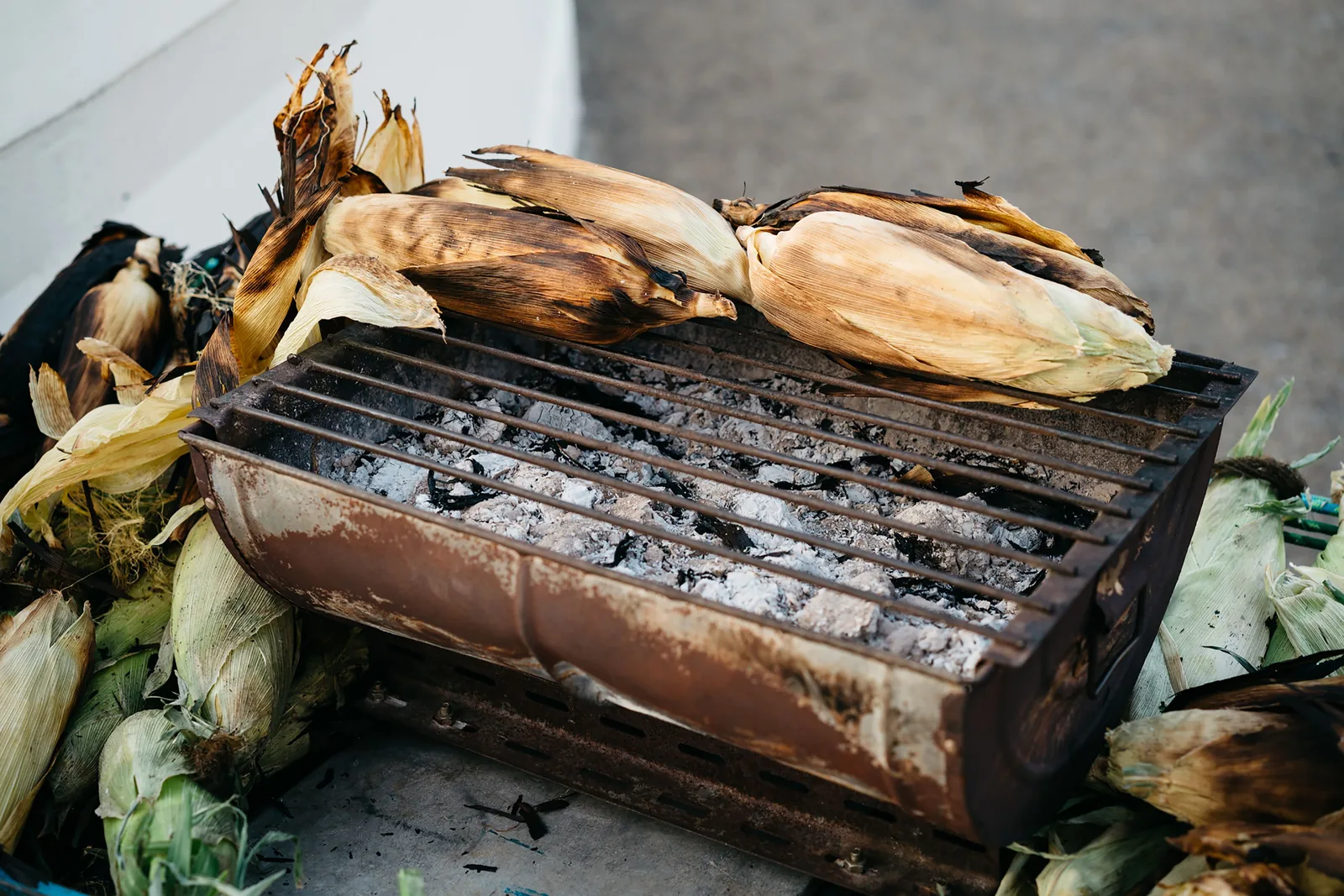
Elote is grilled corn on the cob, coated in something creamy, rolled in crumbly white cheese, and finished with chilli powder and lime. It is sold from carts across Mexico, usually on a stick or with the husk pulled back as a handle, and it is eaten standing up.
The word simply means “corn cob” in Mexican Spanish. What turns a cob into elote as a dish is the dressing, and the order it goes on in: something to make the toppings stick, then cheese, then chilli, then lime last.
What actually goes on an elote
There is no single recipe, but the layers are consistent and each one has a job.
| Layer | Usually | What it is doing |
|---|---|---|
| The base | Mayonnaise, crema, or both | Glue. Nothing else sticks to a wet cob without it |
| The cheese | Cotija, crumbled | Salt and a dry, crumbly texture against the soft kernels |
| The heat | Chilli powder or Tajín | Mild warmth plus, in Tajín’s case, extra salt and lime |
| The acid | Lime, squeezed over at the end | Cuts through the fat so it does not read as heavy |
| Optional | Butter, hot sauce, cilantro | Regional and vendor preference |
Cotija is the traditional cheese: a hard, salty, aged cow’s-milk cheese that crumbles rather than melts. That last part matters. A melting cheese would slide off a hot cob; cotija clings to the mayonnaise and stays where it is put.
Elote and esquites are the same thing, served differently
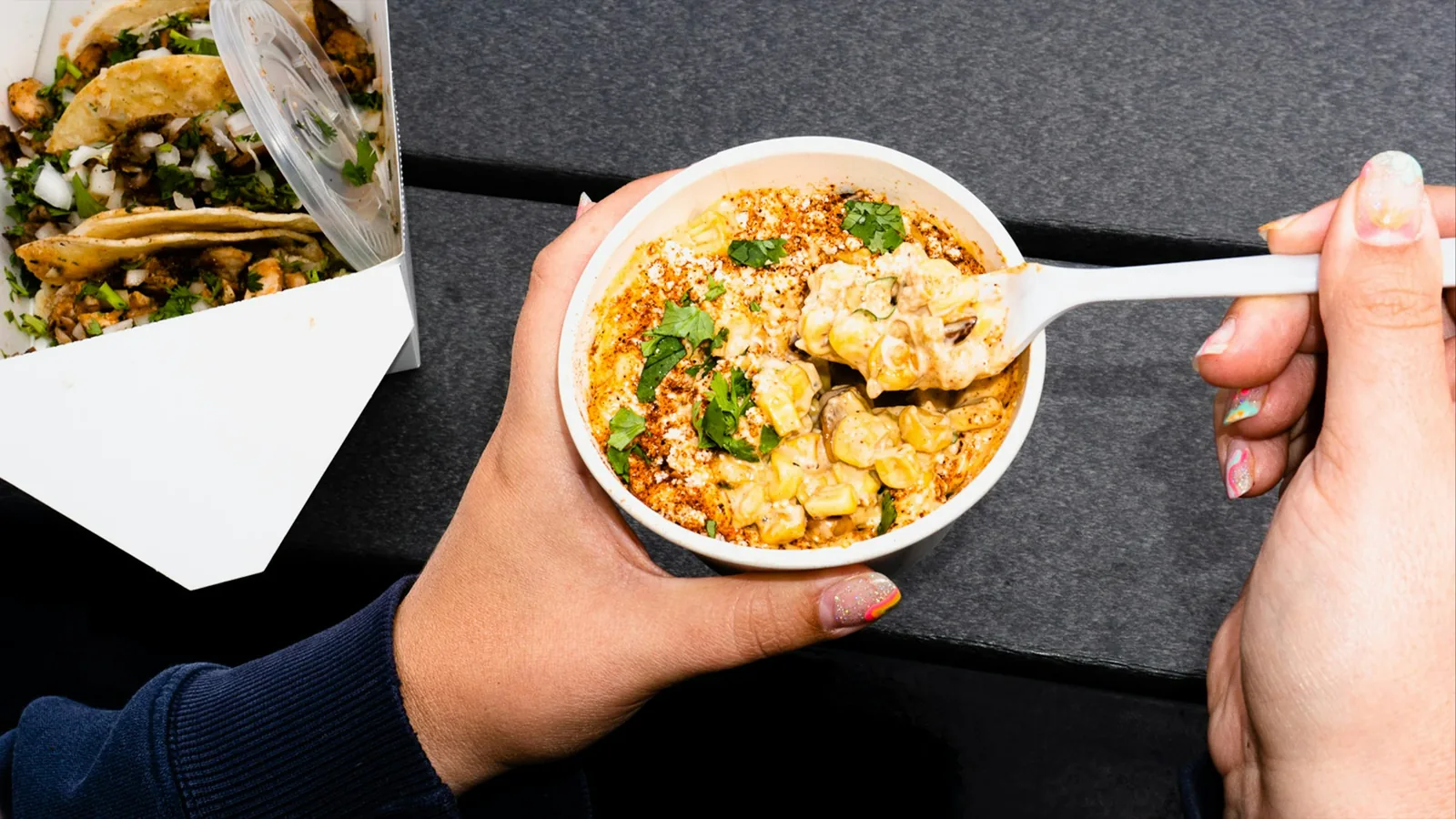
If the corn is off the cob and in a cup, eaten with a spoon, it is usually called esquites. The dressing is identical. Vendors often sell both from the same cart, and in much of the United States the cup version is still sold under the name elote — often as “elote in a cup” — because that is the word customers recognise.
Neither version is more authentic than the other. The cup is simply easier to eat while walking, and it lets a vendor serve corn that has been cut off the cob in advance.
This is not the same corn that becomes a tortilla
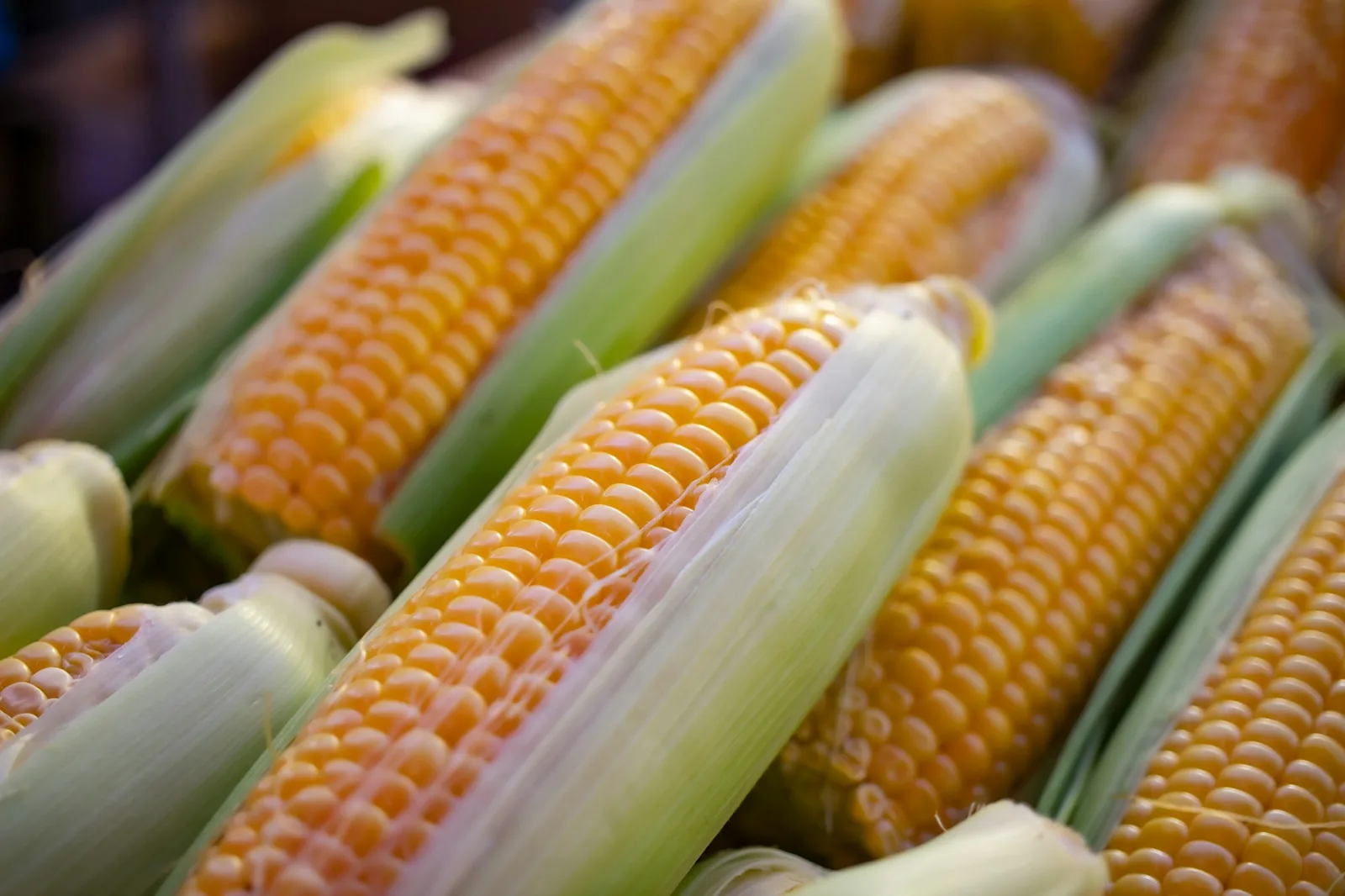
It is a reasonable assumption that all Mexican corn dishes start from the same corn. They do not. Elote uses fresh corn, cooked and eaten as a vegetable. Tortillas, masa and every fried masa dish start from dried field corn that has been simmered in an alkaline solution — lime water — and then steeped, a process called nixtamalisation.
That process is not just tradition. A 2023 study in Frontiers in Nutrition assessing nixtamalised maize tortillas describes lime-cooking maize with roughly one per cent lime, and reports that phytates — compounds that block mineral absorption — are reduced by up to 21 per cent in the process, alongside an increase in calcium. Fresh corn on a grill goes through none of that. It is a different ingredient with a different job.
If you want the tortilla side of that story, we cover how corn and flour tortillas differ separately.
How elote was served at Doc’s Taco Shop
Doc’s Taco Shop in Liberty City, Texas listed elote on its 2023 board as “Elote (Corn-n-Cup)” — the cup version, dressed with mayo, butter, sour cream, Parmesan cheese, lime juice, Tajín seasoning and Valentina sauce. There was also a Loaded Elote, which added a choice of meat and cilantro to the same build.
Two things there are worth naming honestly. The board said Parmesan, not cotija, and sour cream, not crema. Both are common Tex-Mex substitutions, and neither is an error — Parmesan is also hard, salty and crumbly, and it is far easier to buy in East Texas than cotija. It is simply a different, more available version of the same idea — cotija is so often described as the Parmesan of Mexico that the swap is close to a like-for-like. We wrote about which Mexican cheeses melt and which deliberately do not and about what actually separates crema from sour cream if those swaps interest you, and the wider Tex-Mex pattern they belong to.
Doc’s Taco Shop closed permanently on 19 July 2025 after five years in business. The menu details above are transcribed from the restaurant’s own published menu board and are recorded here as history. You can still read the full menu as Doc’s published it or read how the shop came about.

Tajín and Valentina, decoded
Two brand names turn up constantly on elote, including on Doc’s own board, and neither is self-explanatory if you have not met them.
- Tajín is a dry seasoning of mild chilli, dehydrated lime and salt. It is tangy rather than hot — most of what it adds is acidity and salt, with only a gentle warmth behind them. It goes on fruit as often as on corn.
- Valentina is a bottled Mexican hot sauce, thicker and less vinegary than the American style, with a mild, rounded chilli flavour. It is closer to a condiment than a heat source.
Between them they cover salt, acid and mild heat, which is why an elote dressed with both needs very little else. Neither will overwhelm someone who does not like spicy food.
How to eat one without wearing it
- Hold it by the stick or the pulled-back husk, not the middle.
- Turn it as you go rather than eating one stripe all the way along.
- Squeeze the lime yourself, at the end — it should still be sharp when it reaches you.
- Take napkins. More than you think. This is not a tidy food.
If you are ordering it as part of a larger meal, treat a whole cob as a side rather than a starter — it is more filling than it looks. Our guide to how many tacos to order per person factors sides like this into the arithmetic.
Frequently asked questions
What does elote taste like?
Sweet corn against salt and fat, with a mild chilli warmth and a sharp lime finish. It is rich rather than spicy — most of the heat in a standard elote is very gentle.
Is elote spicy?
Usually only mildly. The chilli powder or Tajín used on a standard elote is more about salt and tang than heat. If a vendor offers hot sauce as well, that is where the real heat comes from.
What is the difference between elote and esquites?
Elote is on the cob and eaten in the hand; esquites is the same corn and the same dressing, cut off the cob and eaten from a cup with a spoon. Many places sell the cup version under the name elote.
What cheese goes on elote?
Cotija traditionally — a hard, salty, crumbly aged cheese. Parmesan is a common substitute in the United States because it behaves the same way and is easier to find.
Is elote vegetarian?
The plain version usually is, but check. It normally contains mayo and dairy, so it is not vegan, and loaded versions add meat. See our guides to vegetarian and vegan ordering.
The short version
Elote is corn plus salt, fat, acid and a little heat — four things that make sweet corn taste like more than sweet corn. On the cob it is elote, in a cup it is esquites, and the difference between a traditional build and a Tex-Mex one usually comes down to which cheese and which cream were available.
The Doc’s version is preserved on the archived menu page, and the photo gallery shows what the shop’s food looked like.