
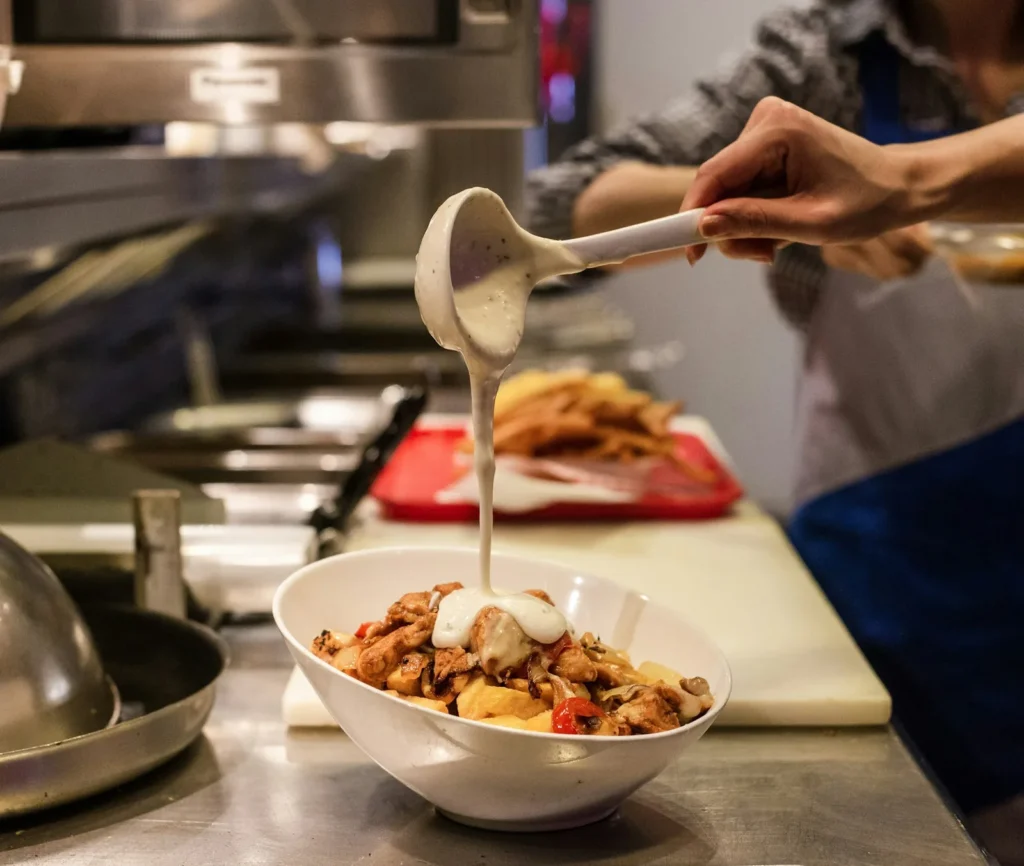
Mexican crema is thinner, milder and higher in fat than sour cream. You can pour it; sour cream you have to spoon. That difference in fat is also why crema can go into a hot dish without splitting and sour cream often cannot.
They are close relatives — both are cream soured by bacterial culture — but they are not interchangeable in every situation, and the reasons are specific rather than a matter of taste.
The difference in one table
| Mexican crema | Sour cream | |
|---|---|---|
| Milkfat | Around 30% | Not less than 18% by federal standard |
| Texture | Pourable, like thin double cream | Thick, spoonable |
| Flavour | Mild, slightly sweet, gently tangy | Distinctly sour and more acidic |
| Thickeners | Usually none | Commonly stabilised and thickened |
| In a hot dish | Resists splitting | Can curdle if it boils |
| Typical use | Drizzled over a finished plate | Spooned on as a topping |
Where the 18 per cent comes from
Sour cream’s figure is not an estimate. In the United States, sour cream is a standardised food with a legal definition. 21 CFR 131.160, the federal standard of identity for sour cream, specifies that it results from souring pasteurised cream with lactic acid–producing bacteria, that it contains not less than 18 per cent milkfat, and that it has a titratable acidity of not less than 0.5 per cent, calculated as lactic acid.
Mexican crema has no equivalent US standard, which is part of why products sold under that name vary so much. What is consistent is that crema sits higher in fat — commonly around 30 per cent — and lower in acidity than the sour cream standard requires. Higher fat, less acid: that pairing explains every other difference on the list.
Why one splits in a hot pan and the other doesn’t
When dairy is heated, the proteins tighten and squeeze out liquid. If there is enough fat in the way, the proteins are kept apart and the sauce stays smooth. If there is not — and especially if the product is already acidic, since acid encourages the same proteins to clump — it separates into grains and watery liquid.
Crema’s higher fat and lower acidity put it on the safe side of that line. Sour cream sits closer to the edge, which is why recipes tell you to temper it, stir it in off the heat, and never let it boil.
The other creams you will see on a Mexican menu
Crema is not one product. Several related creams turn up under Spanish names, and they are not equivalent.
| Name | What it is | Behaves like |
|---|---|---|
| Crema mexicana | The standard table cream, lightly soured | Pourable, mild, faintly sweet |
| Crema agria | A more acidic version | Closer to sour cream |
| Crema fresca | Barely soured, sweeter | Nearest to plain pouring cream |
| Crème fraîche | The French equivalent, high fat | The best substitute for crema mexicana |
If a recipe simply says crema, it almost always means crema mexicana. If a shop sells only crema agria, treat it as sour cream and thin it accordingly.
Substituting one for the other
You usually can, with adjustments. What to do depends on which direction you are going.
- Sour cream in place of crema, cold: works. Thin it with a little milk or lime juice until it pours, or it will sit in lumps instead of drizzling.
- Sour cream in place of crema, hot: risky. Take the pan off the heat first and stir it through at the end.
- Crema in place of sour cream: works, but it is milder and runnier. Expect less tang and do not expect it to sit up in a dollop.
- Greek yoghurt in place of either: the flavour is close enough, but it is lower in fat and more acidic than both, so it is the most likely of all of them to split when heated.
How they are used on a taqueria menu
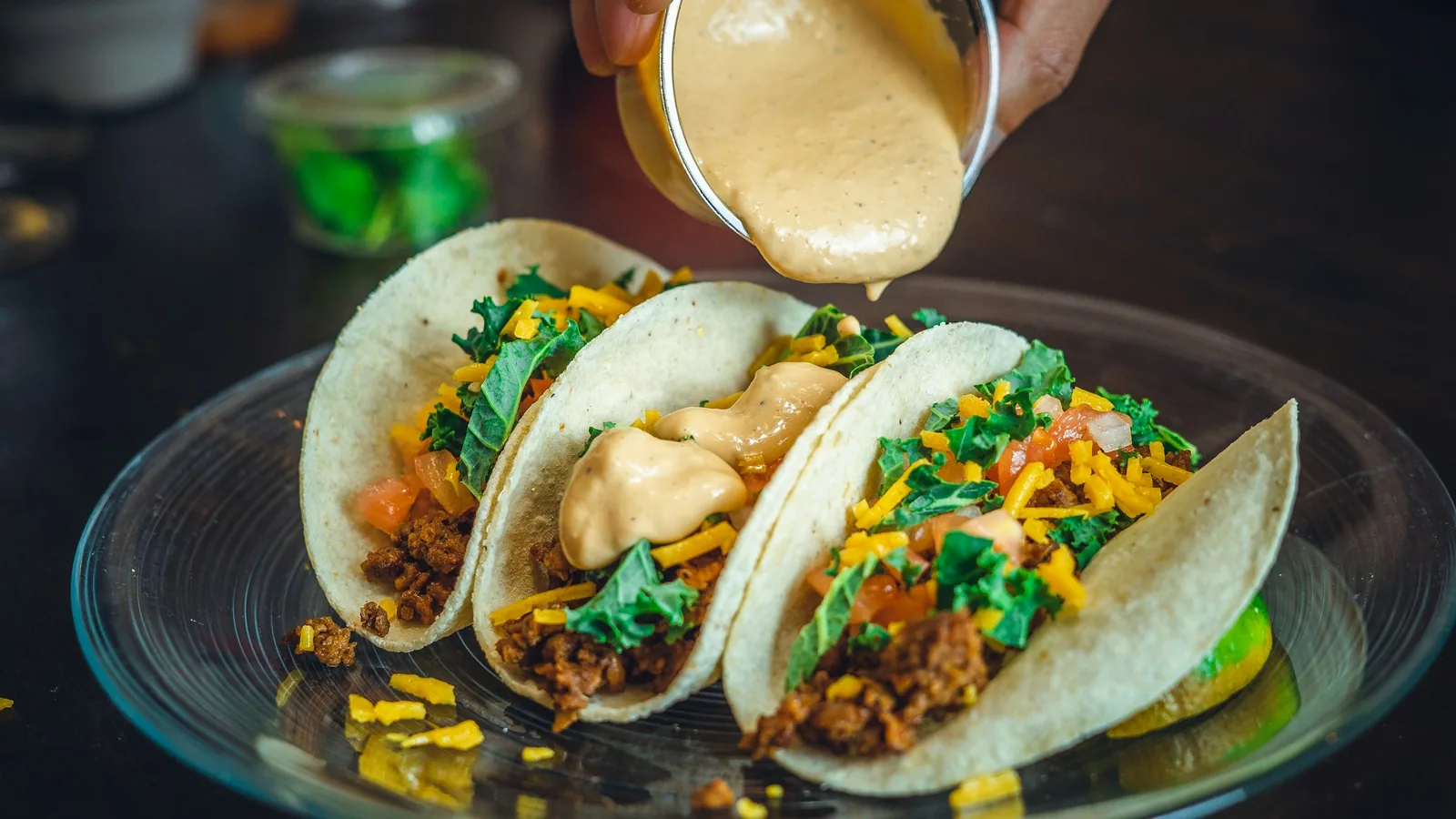
Crema is generally a finishing drizzle, applied after cooking, on dishes that are rich or fried — tostadas, enchiladas, chilaquiles, elote. It softens heat and adds richness without adding a strong flavour of its own.
Sour cream, in Tex-Mex and American-Mexican cooking, is more often a spooned topping in its own right, sitting alongside guacamole and grated cheese. That distinction — drizzle versus dollop — is the quickest way to tell which tradition a menu is drawing on.
Neither appears on a traditional street taco, incidentally. Those are finished with onion, cilantro and lime and very little else, which is one of the clearest markers separating them from American-style tacos.
Which one Doc’s Taco Shop used
Doc’s used both, and its 2023 board is unusually clear about which went where. Crema appeared on The Gringo — a flour-tortilla taco lightly topped with it — and on Keith’s Salad. Sour cream appeared on the chalupa and in both elote builds.
That is a fairly typical East Texas split: the pourable crema used as a finish where a drizzle is wanted, and the thicker sour cream used where the dish needs something to sit on it. Both words appearing on one board is a good sign the kitchen was distinguishing between them deliberately.
Doc’s Taco Shop closed permanently on 19 July 2025 after five years in business. The menu details above are transcribed from the restaurant’s own published menu board and are recorded here as history. You can still read the full menu as Doc’s published it or look through the photo gallery.
Frequently asked questions
Can I use sour cream instead of Mexican crema?
Yes, for cold uses — thin it with a little milk or lime juice so it pours. For hot dishes, be careful: sour cream is more acidic and lower in fat, so it is much more likely to split.
Is Mexican crema the same as crème fraîche?
They are close. Crème fraîche is also high-fat and mild, and it is the best substitute for crema if you can find it. Crema is usually thinner and a little saltier.
Why is my sour cream curdling in a hot sauce?
Heat plus acid. The proteins tighten and separate. Stir it in off the heat, never let it boil, or use a higher-fat cream instead.
Is crema sweet?
Slightly, compared with sour cream, but it is not a sweet product. The impression of sweetness comes from having more fat and less acid.
Which is healthier?
Sour cream is lower in fat. Whether that makes it the better choice depends on how much of it you use — crema’s pourability means a drizzle often delivers less than a spooned dollop does.
The short version
Crema is high-fat, mild and pourable; sour cream is legally defined at not less than 18 per cent milkfat, thicker and sharper. Fat is what keeps a dairy sauce smooth over heat, which is why crema goes into hot dishes and sour cream mostly goes on top of finished ones.